FAQs
How do I know if therapy is right for me?
It’s completely normal to feel unsure — many people wonder if they “need” therapy. If you’re even considering it, that’s usually a sign that you could benefit from a safe, supportive space to talk things through. Your therapist will help you explore your needs and decide if working together feels like the right fit for you.
Why should I choose Breakthrough?
We're glad you asked! Breakthrough Behavioral Health may sound like a large facility, but it's a local, family-owned counseling practice and our excellent, professional counselors treat you like family (while you're in the office of course -- ethics and all that). Our diverse group of counselors are experienced in many evidence-based treatment modalities so we can offer individualized counseling tailor fit for you. Also, we offer unique services such as VR-enhanced Neurofeedback. If you're not familiar with neurofeedback, please check it out here on our website. We believe it's the future of mental health. Not to oversell it because there absolutely is a place for traditional "talk therapy," but when combined with neuroscience, the positive effects we've seen can't be denied. All counselors at Breakthrough are trained in trauma work and most are trained in EMDR. We have counselors that start at 9 am and counselors that see clients until 8 pm. We also have counselors that do weekends. For your convenience, we offer both in-person and telehealth appointments. We accept many commercial insurance plans. Our cash rates are very fair; meaning you get what you pay for. The national profit-making agencies do tend to cost slightly less but, frankly, our counselors are better trained and actually like where they work. Please see our Team page for individual counselor profiles. We hope to hear from you soon!
What can I expect in my first session?
Your first session is a chance for you and your therapist to get to know each other. We’ll talk about what brought you in, what you hope to get from therapy, and any questions you might have. There’s no pressure to share more than you feel ready for — think of it as a conversation to help us understand how we can best support you.
How often will I need to come to therapy?
How often you meet with your therapist depends on your needs and goals. Many clients start with weekly or bi-weekly sessions to build consistency and trust. Over time, you and your therapist will check in and adjust the frequency based on what works best for you.
How long is each session?
Individual sessions with our therapists typically last about 55 minutes. Group sessions are usually 90 minutes, but we’ll always let you know the length ahead of time.
Do you accept insurance?
Our practice accepts several insurance plans and offers cash-pay sessions as well. Please see our Insurance Accepted page for additional information.
How do I know if you accept my insurance?
All we need is your full legal name, your insurance ID number, and your birthdate. Then we will check your insurance company’s benefits from their provider website and, if needed, we will also call them to confirm your coverage, deductible, and co-payment amount . We will then send you an email explaining the benefits that your insurance gave us. This will be done at least before 24 hours prior to your first appointment but most likely within 24 hours of you giving us your information.
How much does therapy cost?
Our cash rates for individual sessions range from $95 to $150, depending on provider licensure and experience. Group sessions start at $30 per session. We are also contracted with several insurance companies. Please see our Insurance Accepted page for additional information. Depending on your insurance company, Breakthrough may have a “facility” contract or a “professional” contract. In most cases, this means that your cost at Breakthrough will be less than other places, but not always. It depends on your specific plan.
Do you offer a sliding scale fee for those who cannot afford therapy services?
Yes, for current clients who have a temporary, qualifying need, each counselor at Breakthrough can offer a limited number of sliding fees or pro-bono.
Can I use my Health Savings Account (HSA) or Flexible Spending Account (FSA) to pay for therapy services?
Absolutely!
What if I need to cancel or reschedule?
We understand that life can be unpredictable! Please give us at least 24 hours’ notice if you need to cancel or reschedule to avoid a late cancellation fee. We’ll do our best to find another time that works for you.
Is what I share in therapy confidential?
Yes — your privacy is extremely important to us. Everything you share with your therapist is confidential, with a few legal exceptions related to safety. These are discussed thoroughly in your intake paperwork. Additionally, your counselor will offer to review confidentiality in detail during your first session and answer any questions you have.
Do you provide medication management?
No - we exclusively provide counseling, DUI screening, and neurofeedback services. However, we are happy to provide a list of physicians that we collaborate with for medication management. Please see our page here.
How do I get started?
Getting started is simple: reach out to us by email, phone, the chat (on the lower-right of the screen) or the contact form on our website. We’ll get back to you promptly to answer any questions and help you schedule your first appointment. You’ve already done the hardest part — looking for support. We’re here when you’re ready.
Why doesn’t Breakthrough do free, 15-minute consultations?
The first, and most important , reason is that we don’t believe that you can really get to know someone in 15 minutes and we really don’t want to waste your time. This is exactly what the first session is for and it’s a full hour — give or take a few minutes.
Counselors don’t typically have a 15 minute block during their day because taking 15 minutes out of any given hour means that the counselor can’t schedule any clients for that entire hour. Other than a few supervisors, our counselors are paid by the hour. We don’t think it’s fair to ask a counselor to give up a slot for an entire hour session without pay.
If you really feel the need to meet with a potential counselor without having to pay a copay, may employers offer a few 45-minute EAP sessions that are paid for in full by the company that offers you insurance benefits. That is exactly what an EAP is so please ask your HR about using some EAP sessions to “shop around” for a counselor that fits your needs.
Where can I learn more about Neurofeedback?
Check out our blog. If that explanation is a bit too technical, try this simplified version:
You remember that experiment by Pavlov and his dogs where he used Classical Conditioning to train the dogs to salivate every time a bell rang even though there was no longer any food being offered? Well, neurofeedback is kind of like that but every time your brain waves are in the frequencies they are supposed to be at for optimal mental health (food), the pleasant video plays (bell) and shows your brain what is healthy. Your brain learns by the feedback and the waves stay in the correct ranges more often (salivation).
What do I have to do to set up a DUI screening or start a Revocation application for court-ordered or ADOT ordered screenings?
Call the office and get set up on a counselor’s calendar.
Complete the online forms.
Get an Extended MVR online. Your counselor will send you information about how to get this before your screening appointment.
How did Breakthrough get started?
Funny story! Our owner rented a small office on February 2nd, 2020 to see a few clients part-time while still teaching at a local university. Two weeks later, the world went into panic mode and the need for mental health services skyrocketed. Breakthrough became a refuge for outstanding counselors that thrived from a supportive, calm environment in a time of uncertainty. Yes, the practice grew but making huge profits was never the point of the "business" so there wasn't a need to pressure the providers. Counselors had significant autonomy and were well-trained and compensated. After all, happy counselors meant more competent care. Word spread. Now, a good portion of our clients are from direct referrals. You may ask, "but why don't you have a ton of ratings?" Glad you asked! That's because the ACA Code of Ethics specifically says counselors can't solicit reviews. So we don't. We just quietly provide high-quality, personalized care. If we sound like your kind of people, give us a call.
What types of issues do counselors at Breakthrough work with?
Our counselors treat a wide range of issues. For example, we treat Academic Struggles, Addictions, ADHD, Anger, Attachment issues, Autism, Bipolar, emotions related to Cancer diagnosis, Couples counseling, Divorce, Domestic
Violence, Eating Disorders, Existential Angst, Family, Grief, LGBTQIA+ specific issues, OCD, Parenting, Self-esteem issues, Sex Therapy, Social Anxiety, Somatic symptoms, Spirituality, Sports, Teen issues, Trauma, Weight Loss, and Woman's issues.
What types of issues do counselors at Breakthrough NOT work with?
Breakthrough counselors are highly trained in their areas of expertise and, for ethical reasons, do not practice outside of their scope of practice. For this reason, we tend to stay away from the category of “Seriously Mentally Ill (SMI).” We also do not get involved in any cases that involve legal battles between parties. We do not offer to complete FMLA or Short Term Disability paperwork. We would refer out to specialists in these cases.
What treatment approaches do counselors at Breakthrough practice?
We have a counselor that can help you in almost any way that resonates with your needs. For example, our best practices approaches include:
Acceptance and Commitment (ACT)
Art Therapy
Attachment-based
Biofeedback
Christian Counseling
Coaching
Cognitive Behavioral (CBT)
Cognitive Processing (CPT)
Compassion Focused
Culturally Sensitive
Dialectical (DBT)
Eclectic
EMDR
Emotionally Focused
Existential
Exposure Response Prevention
Family / Marital
Family Systems
Feminist
Gottman Method
Humanistic
Internal Family Systems (IFS)
Interpersonal
Mindfulness-Based (MBCT)
Motivational Interviewing
Multicultural
Narrative
Neurofeedback
Person-Centered
Positive Psychology
Psychodynamic
Rational Emotive Behavior (REBT)
Schema Therapy
Solution Focused Brief (SFBT)
Somatic
Strength-Based
Structural Family Therapy
Transpersonal
Trauma Focused
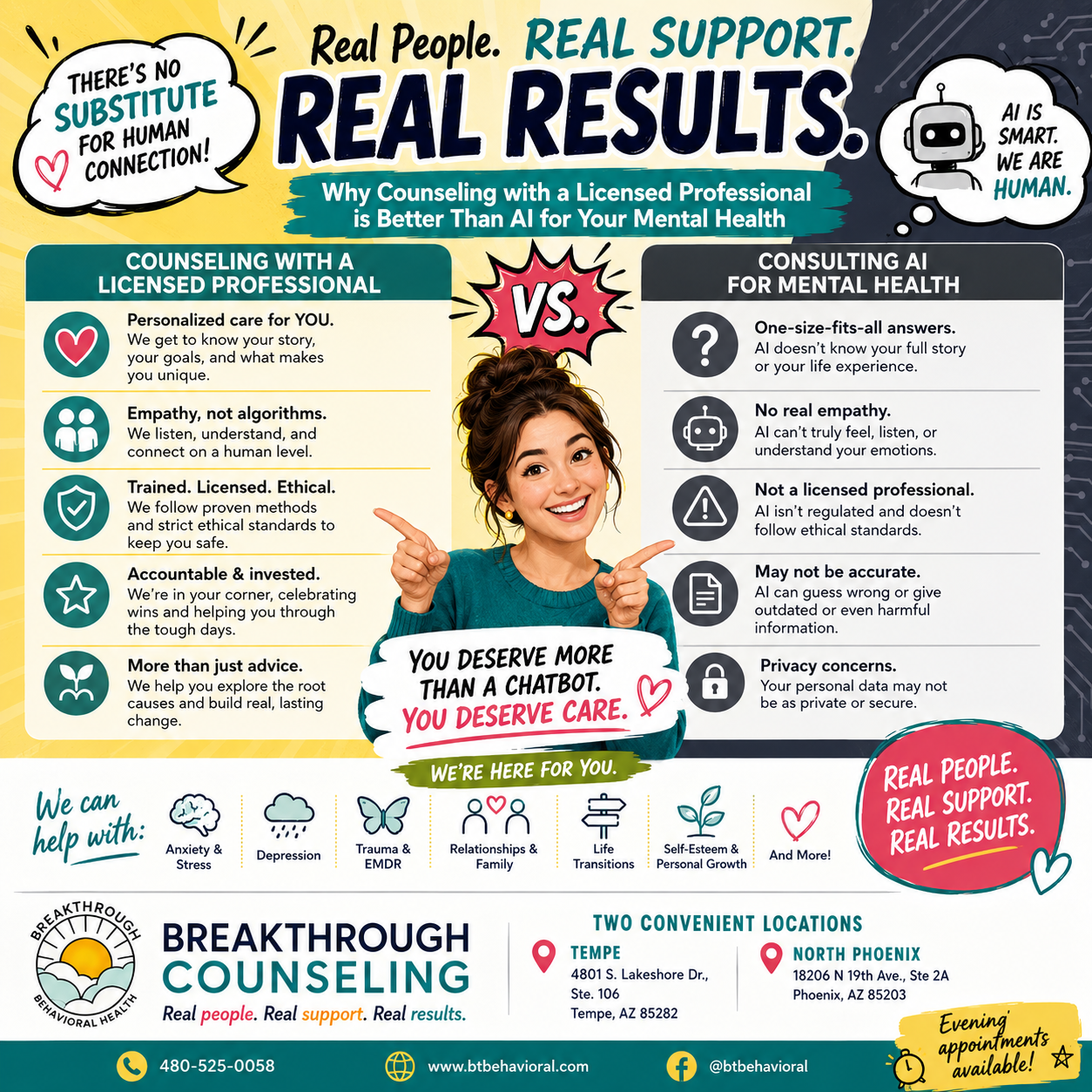
Ironically, we asked ChatGPT if it would recommend AI over seeking a licensed counselor. This was its reply.